
Foreign Bank Account Reporting (FBAR)

If you’re a U.S. citizen or green card holder living abroad, there’s a good chance you’re required to file an FBAR — even if you owe no U.S. tax. It’s one of the most commonly missed filing requirements for Americans abroad, and one of the most costly to get wrong.
- U.S. citizens and green card holders with more than $10,000 in foreign accounts at any point during the year are required to file an FBAR — regardless of whether they owe any U.S. tax
- The $10,000 threshold is cumulative across all foreign accounts, not per account
- FBAR covers far more than bank accounts — investment accounts, insurance policies, pension plans, TFSA, RESP, and Superannuation may all be reportable
- The FBAR is filed with the U.S. Treasury, not the IRS — it is separate from your tax return
- Penalties for non-compliance are severe — up to $10,000 per year for non-willful violations, significantly more for willful violations
- If you have unfiled FBARs from prior years, compliance programs are available that may waive penalties entirely
FBAR stands for Foreign Bank Account Report. Officially it’s FinCEN Report 114 — a report filed with the U.S. Department of the Treasury, not the IRS. Despite the name, it covers far more than bank accounts.
The FBAR exists because the U.S. government requires its citizens and residents to disclose financial accounts held outside the United States. It’s part of a broader effort to identify U.S. persons with unreported foreign income and assets — and it carries its own separate penalty structure, independent of your tax return.
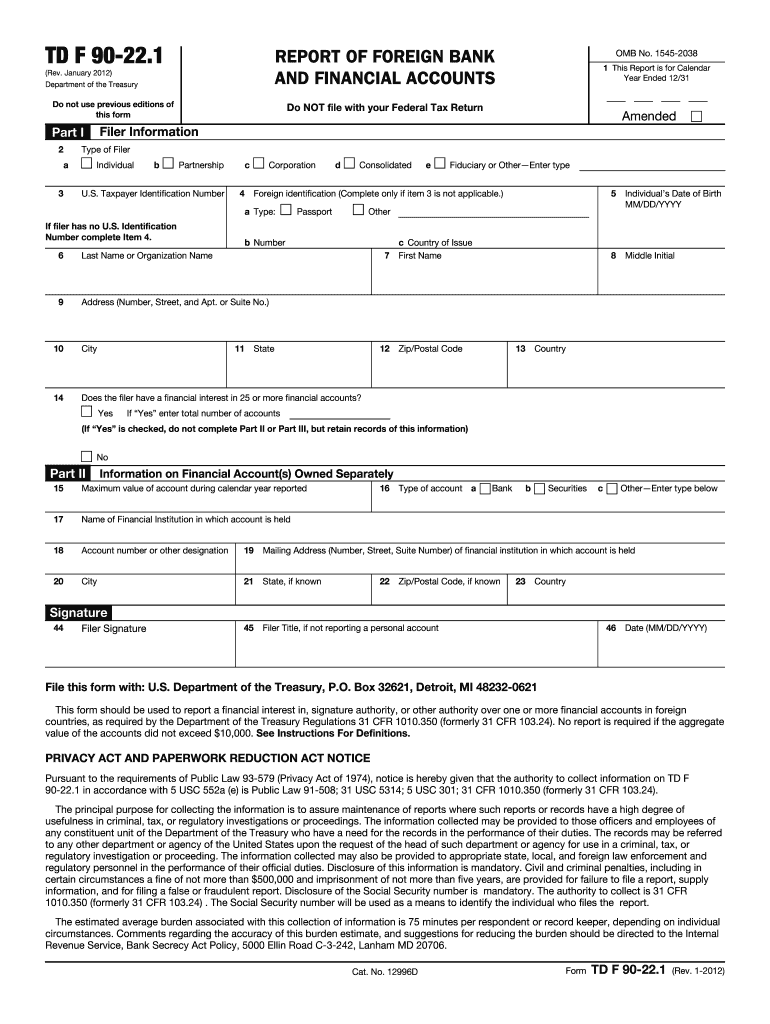
You are required to file an FBAR if all five of the following apply:
- You are a U.S. person — a U.S. citizen, green card holder, or resident alien who meets the substantial presence test
- You have one or more financial accounts located outside the United States
- You have a financial interest in, or signature authority over, those accounts
- The aggregate value of all foreign financial accounts exceeded $10,000 USD at any point during the calendar year
- You are not otherwise exempt
A few things worth noting:
- The $10,000 threshold is cumulative — if you have three accounts with $4,000 each, you have crossed the threshold and must report all three
- Expired green cards still count — until you formally surrender your green card using Form I-407, you remain a U.S. person for FBAR purposes
- Signature authority counts even if you have no financial interest — if you can control the disposition of assets in an account by signing a document, you may be required to report it
- The threshold is based on the highest balance at any point during the year, not the December 31 balance
This is where most people are surprised. A foreign financial account is broadly defined and includes far more than a simple checking or savings account.
Accounts that must be reported include:
- Bank accounts — checking, savings, deposit, time deposit
- Investment and brokerage accounts
- Mutual fund accounts
- Securities and derivatives accounts
- Insurance policies with a cash surrender value
- Annuity policies with a cash value
- Accounts maintained at a financial institution physically located outside the United States — including branches of U.S. banks located abroad
- Employer-sponsored accounts you have signing authority over
- Accounts belonging to family members that you have signing authority over
Accounts that are commonly misunderstood:
- RRSP and RRIF: reportable as foreign financial accounts
- TFSA: reportable, and may also trigger Form 3520/3520A as a foreign trust
- RESP: reportable, and may also trigger Form 3520/3520A
- Superannuation: reportable for U.S. persons in Australia
- ISA: reportable for U.S. persons in the United Kingdom
- Pension accounts: depends on the structure; your Tax Specialist will confirm
Not sure if a specific account needs to be reported? The safest approach is to disclose. The penalty for failing to report a required account significantly exceeds the cost of reporting one that turns out not to be required.
Filing method
The FBAR must be filed electronically through FinCEN’s BSA E-Filing System. It cannot be mailed. Your AET Tax Specialist can prepare and e-file your FBAR on your behalf as part of your engagement.
Deadline
April 15, following the calendar year being reported.
Automatic extension
An automatic extension to October 15 is granted — no action required to receive it.
Important
The FBAR is filed separately from your tax return. It goes to the U.S. Treasury, not the IRS. Filing your tax return does not fulfill your FBAR obligation.
Currency conversion
Report all account values in U.S. dollars using the official Treasury exchange rate in effect on December 31 of the reporting year. For Canadian dollar accounts, AET maintains a current exchange rate reference. See FBAR Exchange Rates: CAD to USD here.
FBAR penalties are among the most severe in U.S. tax law — and they apply per account, per year. Understanding the stakes is important.
Non-willful violations—failure to file due to negligence, inadvertence, or a genuine misunderstanding of the law:
- Up to $10,000 per violation per year
- Following the Bittner v. United States Supreme Court decision (2023), the penalty for non-willful violations applies per form, not per account — a significant reduction in potential exposure for most filers
Willful violations—knowing failure to file, or reckless disregard of the requirement:
- The greater of $100,000 or 50% of the account balance per violation per year
- Criminal penalties may also apply in egregious cases
The statute of limitations is six years—meaning the current year and the six prior years may be subject to examination.
If you have unfiled FBARs from prior years, acting now matters. The IRS has compliance programs — including the Streamlined Foreign Offshore Procedures — that allow eligible filers to catch up without the full penalty exposure that applies outside those programs. These programs are not guaranteed to remain available. Learn more about Streamlined Filing.
If you have missed FBAR filings — whether for one year or many — you are not alone. Many Americans abroad were simply unaware of the requirement. The good news is that there are formal compliance programs designed specifically for this situation.
Streamlined Foreign Offshore Procedures
For U.S. persons living outside the United States who can certify that the failure to file was non-willful. Penalties are waived entirely under this program.
Delinquent FBAR Submission Procedures
for filers who have no unreported income but simply failed to file the FBAR. Available outside the streamlined program in certain circumstances.
Voluntary disclosure
for situations involving willful non-compliance, a separate program exists with different terms.
The right path depends on your specific situation. An AET Tax Specialist can review your circumstances and recommend the appropriate approach.
Not sure which program applies to you?
If AET is preparing your FBAR, you’ll need to provide the following for each foreign financial account:
- Name of the financial institution
- Country where the account is located
- Account number or other identifier
- Type of account
- Highest balance during the calendar year (in the foreign currency — AET will handle the conversion)
- Your ownership status — financial interest, signature authority, or both
Frequently Asked Questions
Yes — the FBAR is a separate reporting requirement from your tax return. Whether or not you owe tax has no bearing on whether you are required to file an FBAR. The trigger is the account balance, not your tax liability.
They overlap but are not the same. Both require disclosure of foreign financial assets, but they have different thresholds, different filers, different assets covered, and different filing destinations. Many expats are required to file both. The FBAR goes to the Treasury; Form 8938 is attached to your tax return and goes to the IRS. See our comparison of FBAR and Form 8938
FBAR reporting applies to all accounts regardless of how many you have. Pricing differs slightly — up to 10 accounts: $180 / more than 10 accounts: $325. AET provides a multi-year FBAR worksheet for clients with complex account histories.
Use the official U.S. Treasury exchange rate in effect on December 31 of the year being reported. For Canadian dollar accounts, see our FBAR Exchange Rates reference page. For other currencies, historical Treasury rates are available at fiscaldata.treasury.gov.
Yes — FBAR preparation and filing is available as a standalone service. Starting at $180 for up to 10 accounts.
For first-time FBAR filers, a one-time setup fee of $95 applies to establish your account history and prior year balances. This fee is not charged in subsequent years.
Possibly — signature authority over an account can trigger an FBAR obligation even if you have no personal financial interest in the account. There are exceptions for certain employees of publicly traded companies and financial institutions. Your Tax Specialist can confirm whether your specific situation requires reporting.
